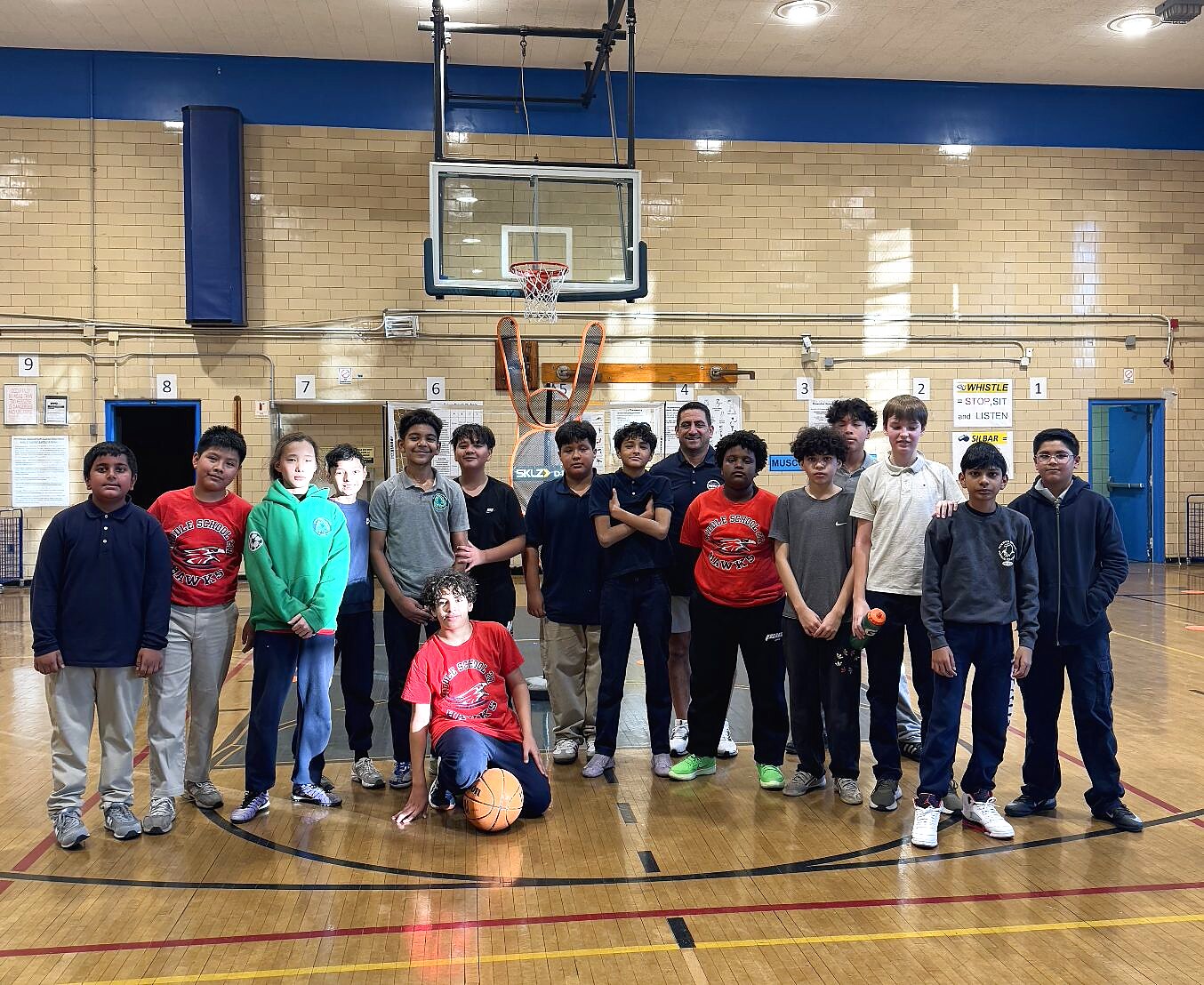
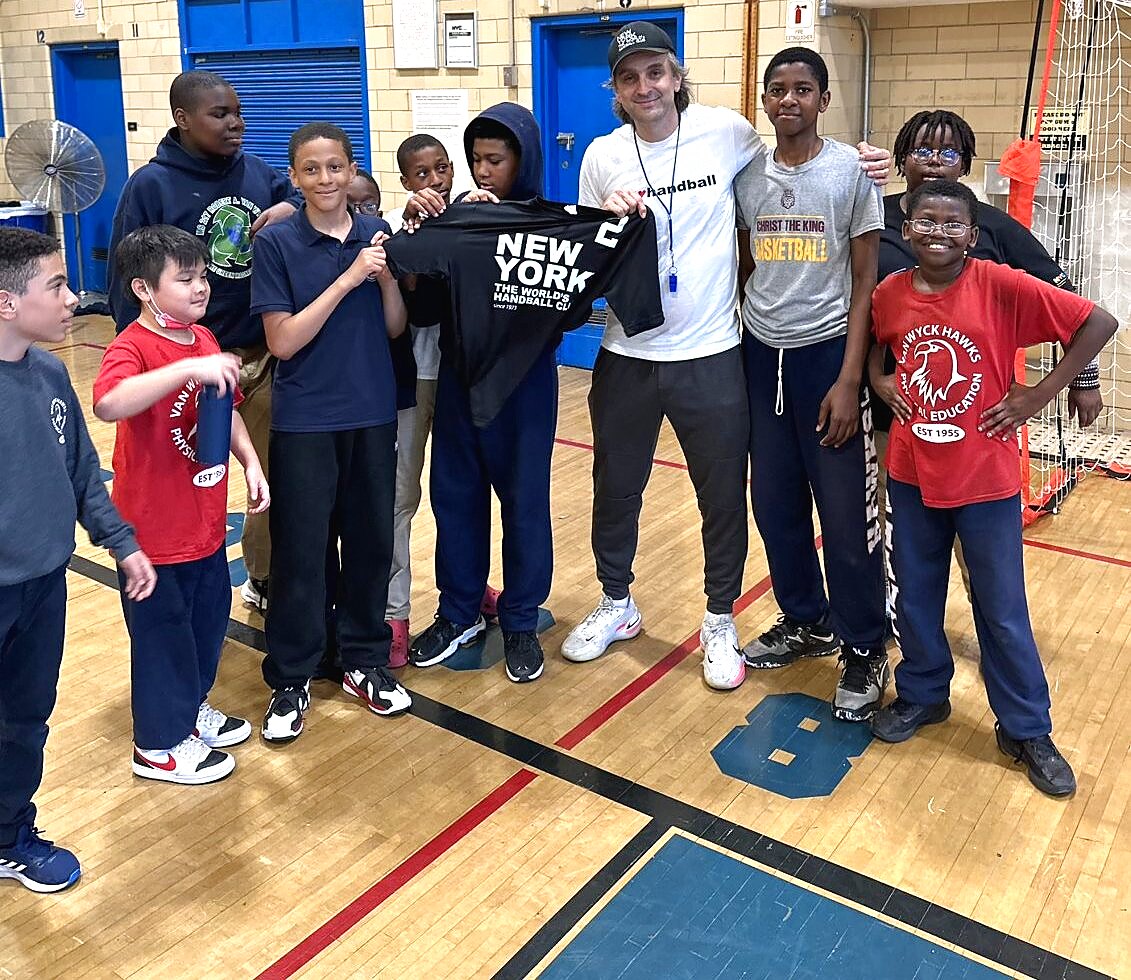
An 11-week Olympic Handball unit, delivered by our coaches inside your existing PE schedule and built for real class sizes of 65–90 students. We run it in elementary, middle and high schools. Your PE staff supervises; we bring the curriculum, the coaching and the sport.
From district public schools to Queens Community House and Grand Street Settlement programs, and international schools such as the German International School and the Lycée Français de New York, we serve the full diversity of New York City.
Schools and partners we’ve served

“Our students count down the days to handball. The energy these coaches bring is something our schedule simply couldn’t generate on its own.”
Large classes, stretched staffing and demanding state requirements are the reality of NYC physical education. This unit gives your students an Olympic sport most New York City schools cannot otherwise offer, with no extra burden on your staff.
90 minutes weekly, from structured warm-up to reflection, culminating in a school tournament with sportsmanship awards.
Mapped indicator by indicator to the Grade 3–5, 6–8 and 9–12 learning indicators across all four national standards, and to the New York State PE Learning Standards (2020).
The seven Olympic & Paralympic values and CASEL-aligned SEL practices, woven into every session.
Three fluid challenge levels, so first-time movers and experienced athletes are both genuinely challenged.
Baseline-to-final growth data, participation rates and student reflections, delivered to you at the end of the unit.
Teachers can grade it, after-school programs keep booking it, and the NYC Youth Cup fills a gym with 300 middle schoolers every year. If you run a COMPASS, SONYC or Beacon site, we already fit the enrichment block: we work inside them with Queens Community House and Grand Street Settlement.
European handball has been a great addition to our PE program. Every student is engaged, running, moving, learning and part of a team, and we can watch and grade them as they go. These guys are pros, and they get every student excited to participate. Kids show up on time for their sessions and are more engaged and energetic the rest of the day.
Adding European handball to our program has been incredible, especially given how strong France is in the sport. NYCTHC runs a tight, professional competition and is easy to work with. Students from seven schools compete fairly and inclusively, and at the end we all celebrate what the Olympic spirit is about: friendship, the pursuit of excellence and teamwork. We love doing this every year.
We’ve worked with NYCTH for five years now, and our kids love European handball. They always ask for it. It’s a great team sport, and the fact that it’s co-ed has made it a great addition to our enrichment activities.
Our kids love European handball, and the NYCTH staff is incredible at getting every one of them involved. It’s been a great hit with our programs.
Sessions run in collaboration with, and under the supervision of, your certified PE teacher(s), as New York State requires for grades 7–8, so instruction counts toward your PE program.
The unit serves as one of your required weekly PE sessions, contributing toward the state’s 90-minutes-per-week requirement. It complements your program; it does not replace it.
No lesson planning, no staff training, no curriculum writing. Equipment is minimal and coordinated with the club.
The same 11-week arc, the same coaches and the same values, written three times: for the fundamental-movement years, for middle school classes of 65–90, and for the credit-bearing high school course. Each package has a principal brief, a one-page overview for the PE teacher, the full week-by-week curriculum, the SHAPE America 2024 and New York State crosswalk, assessment rubrics and safety protocols.
45-minute sessions, a soft size-0 ball, four corners, three color levels, a closing festival where every team plays every game. Adaptations for K–2 included. 20 Grade 3–5 indicators.
90-minute sessions built for 65–90 students: station rotation, peer leaders, three differentiated levels, student referees and a culminating tournament with a Sportsmanship Award. 24 Grade 6–8 indicators.
90 minutes or two 45-minute periods inside the credit-bearing course: 6-0 and 5-1 defenses, heart-rate and RPE concepts, student referees, scorekeepers and analysts, the Olympic Handball Cup. 22 Grade 9–12 indicators.
What is handball? Catching, passing, rules, team identity.
Throwing, defense, goalkeeping, three challenge levels, first full game.
Leveled teams, captains, sportsmanship, a culminating tournament with awards.
Social-emotional learning does not need a worksheet. European handball runs all five CASEL competencies live, every session, where your PE teacher can watch them happen.
Offense to defense every few seconds. Kids learn their limits, their fatigue, their triggers after a missed shot or a call, and what they are good at.
No time to sulk. A mistake means get back on defense, now. Defend hard without a dangerous foul. Regulate, reset, go again.
Read the court: where teammates are, what opponents intend. When a teammate drops a pass, the team’s response is the lesson.
Nothing works without talking. Fast breaks and defensive switches run on calls and signals, and disagreements get settled before the next possession.
Shoot, pass or drive? Dozens of split-second choices a game, each with a consequence for seven people, inside the rules and fair play.
A one-page version for your PE department and administration, ready to forward.
Download the CASEL one-pager (PDF)CASEL® and the CASEL 5 are the framework of the Collaborative for Academic, Social, and Emotional Learning. Handball Rising is not affiliated with CASEL.
One morning a week reaches the students who need us most and two full PE classes.
Students who need help arriving on time, extra activity or social-emotional support. Handball builds confidence and a team to belong to.
A full class learns the sport during physical education.
Another full class, a completely new group.
October–January, then February–May. The whole school, every year.
Because the research is clear: who delivers it changes the outcome. The specialist is the program.
more active minutes per lesson when PE is taught by specialists rather than generalist teachers, in a 4-year randomized trial of 29 schools.
Youth with a sporting role model are about twice as likely to meet activity guidelines, and coaches rank among the most influential. Ours are in the gym every week.
PE teachers show high emotional exhaustion. We carry the engagement load, and your staff get real relief.
Frontiers in Human Neuroscience 2021, meta-analysis of 12 studies
You’re not buying a curriculum. You’re buying expert delivery of one.
No. Activity time doesn’t hurt academics, and quality PE, the kind that gets kids moving more in class, is the format most linked to sharper cognition and stronger math scores.
Sources: García-Hermoso et al., Br J Sports Med 2021; Loturco et al., Education Sciences 2022, 31 studies.
A full year of expert coaching, competition, Olympian visits and Team USA pathways, reaching 260–360 students.
You don’t fund the full program. You host it. We bring the rest.
Give us gym time and a place on your schedule. We bring the coaches, equipment and curriculum.
Lend your name and your trust. A principal’s confidence opens doors with families and funders.
A modest share from enrichment or PE funds. We raise the remaining majority from donors and foundations.
It can scale to your budget: a full-strength program at $35K, or a focused version for less. Let’s find what works.
one student, one year, in a city-funded after-school program
twenty students, each through a full 11-week Olympic sport unit, at ~$150 a student
Same money. Twenty times the kids, or more. And a ladder they can climb.
Same price as an hour of after-school. Different hour.
The arithmetic: $150 ÷ 16.5 hours (11 sessions × 90 minutes) = $9.09. $4,900, the Council’s proposed COMPASS rate (NYC Council, May 2025), ÷ 540 hours (three hours a day, five days a week, 36 weeks, per COMPASS NYC) = $9.07. At $3,000–$4,000 a seat, the city’s hour is about $6–$7, though it is paid per enrolled seat, not per hour attended. Active minutes: Telford et al., 2016.
Different models, and we say so: a COMPASS NYC seat is three hours a day, five days a week, all school year, free to the family, across 890+ programs. City figure: published per-seat rates are $2,800–$3,200 for COMPASS elementary and $3,200 for SONYC middle school, with $4,900 and $4,150 proposed (NYC Council, May 2025); providers we work with report funding at or above the top of our $3,000–$4,000 range. Our figure is a blended average across all students introduced per year.
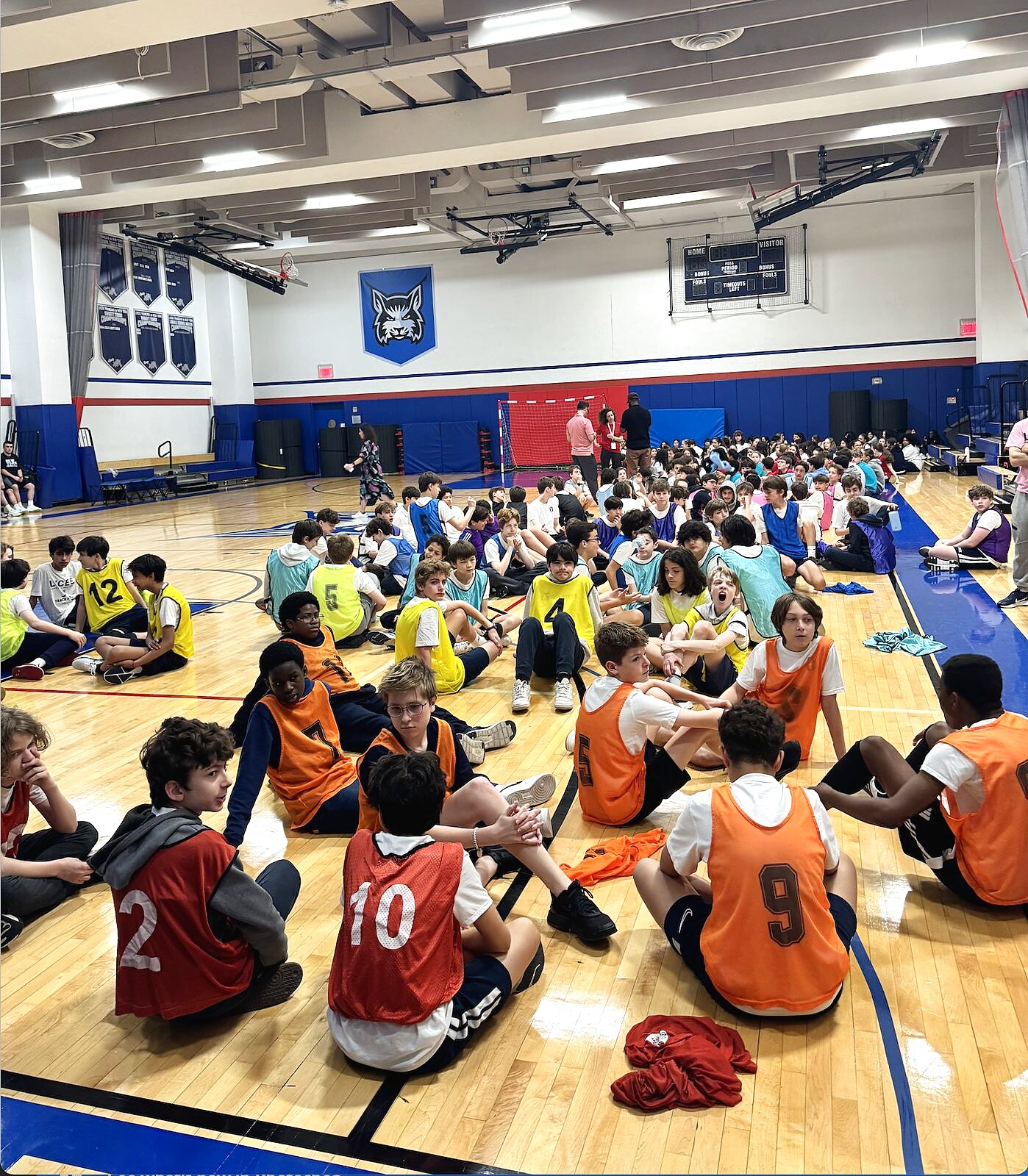
Shkumbin “Bini” Mustafa, Managing Director & Head Coach · 8× U.S. National Champion, former Team USA athlete